Beyond Sudoku: The Prequel
Before we explore rare logic variants, let’s pay homage to the king of the grid

We started this newsletter series on the assumption that there is a vast universe of logic puzzles waiting to be discovered beyond Sudoku. But as we explore deeper paths, it would be unfair not to pause and pay homage to the king that started it all.
Sudoku is the phenomenon that truly popularized deductive grid logic worldwide. It has filled countless puzzle books, sparked global competitions, and kept millions of pencils sharp for decades.
Whether you are a seasoned solver or just looking for a quick logic reset, this is a deep dive into the underlying mechanics of the world’s favorite grid, its wildest variations, and how you can get your hands on a custom, hand-crafted variety pack today.
The Core Rules
The beauty of classic Sudoku lies in its simplicity.
The 9×9 Rule: Fill the grid so that every row, every column, and every 3×3 sub-box contains the numbers 1 through 9 exactly once.
It is important to note that every sound Sudoku must have only one unique solution. While a high number of pre-filled clues often indicates an easier puzzle, this isn’t a hard-and-fast rule—especially once you begin exploring variants.
The Two Essential Techniques
To find the correct paths through any grid, you must train your eyes to use two foundational scanning habits:
1. Cross-Hatching (Scanning the Lines)
Pick a single 3×3 box and look for a number that is missing from it (for example, a 1). Look at the neighboring rows and columns outside that box. If they already contain a 1, drag your eyes across those lines like laser beams. Those lanes are blocked. The remaining open square inside your target box is where your number must go.
2. The Elimination Method (Tracking the Squares)
Pick a single empty square that is already surrounded by a lot of clues. Look at its entire row, its entire column, and its specific 3×3 box. Count the unique numbers already present. If 8 out of the 9 numbers are already used up by its neighbors, then that single square must be the one missing number.
Pro-Tips for Clean Solving
Leave the Pen Behind: True logic enthusiasts solve with a sharp pencil and a good eraser. It keeps your grid clean and prevents visual clutter when testing a theory.
Target the Heavy Lines: Always start your scan with the rows, columns, or boxes that already have the most numbers filled in (5 or 6 clues). They have the fewest variables left to solve.
Trust the Logic: If you feel forced to guess between two numbers, step back. You haven’t encountered a broken puzzle—you’ve just missed a subtle interaction somewhere else on the board.
The Wild World of Sudoku Variants
The sheer number of custom variants out there is the ultimate proof of how loved this puzzle is. Designers love pushing the boundaries of the grid, starting with the simplest modification: scale.
While 9×9 is the golden standard, we can scale down to a 6×6 mini-grid (which relies on tighter, compact logic constraints) or shoot up into the stratosphere. If you scale up to a 16×16 grid, the complexity doesn’t just increase—it sky-rockets. At that size, it becomes less about finding the logic and more about how much paper you have and how many hours you are willing to spend!
But things get truly beautiful when we change the rules entirely. Here are some of the most famous variants shaking up the puzzle world today:
Sudoku X: The closest sibling to the classic. The standard rules apply, but the numbers 1 through 9 must also be placed perfectly along the two main diagonals of the square.
Jigsaw Sudoku: Instead of standard 3×3 square sub-boxes, the grid is carved into irregular, interlocking puzzle shapes. Difficulty here depends heavily on the geometry of the shapes themselves, forcing you to discover entirely new types of spatial logic. This actually deserves its own text because shape setup can become really beautiful.
Killer Sudoku: Inside an empty grid, you are given dashed cages with small numbers in the corners. These numbers tell you the exact mathematical sum of the digits inside that cage, combining basic arithmetic with pure elimination logic.
Greater/Less Than Sudoku: Rather than giving you pre-filled number clues, the grid lines are filled with math symbols (> or < ) dictates which neighboring cells must hold higher or lower values.
Consecutive Sudoku: Special markers are placed between cells to indicate that the numbers inside them must be consecutive (e.g., a 4 next to a 5).
Windoku: A standard classic grid, but with four additional shaded 3×3 regions overlapping the background, each requiring the digits 1 through 9.
Thermo Sudoku: Thermostat shapes are mapped across the grid. The numbers must strictly rise in value as you move from the bulb to the tip of the thermometer—a beautiful variant of the Greater-Than concept.
The Multi-Grid and Geometric Horizons
Why stop at a single board? Samurai Sudoku links 5 standard grids together, overlapping at the corner boxes, turning a sprint into an epic logical marathon. Samurai is the most famous variant but you can link any number of grids from 2 to n. Designers have even broken free of square paper entirely, mapping Sudoku logic onto hexagonal and triangular grids where tracking your rows and columns requires a complete realignment of your visual perspective.
Putting the Blueprint to the Test (A 6×6 Walkthrough)
Let’s apply these guidelines to the custom 6×6 variant grid below to see how these chains of deduction connect in real time.
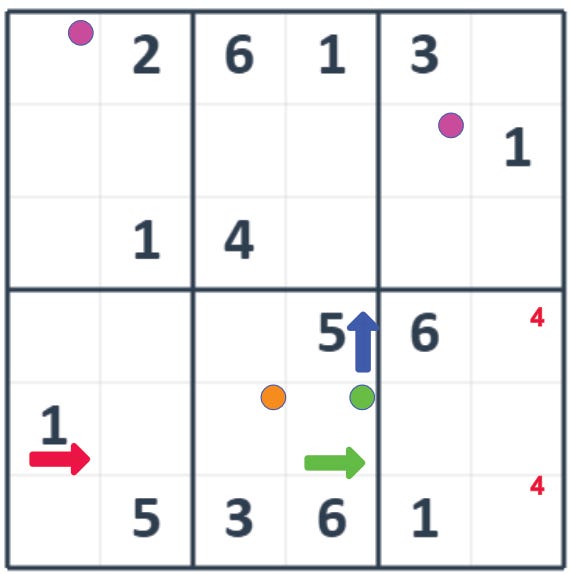
The Red Arrow (Finding 1): Start at the 1 marked by the red arrow. Follow the direction of the arrow into the bottom-left region. You will notice that this 1 blocks out its entire row, eliminating all free cells in that region except one. Go ahead and place a 1 in that single open cell at the bottom of the column.
The Blue Arrow (Finding 5): Now look at the 5 with the blue arrow sitting right next to the 1 you just placed. If you trace the arrow’s path upward into the top-left region, you’ll see that it blocks its column, leaving only one possible cell where a 5 can be placed.
The Orange Dot (Finding 2): Look at the column where you just established the 1 and the 5. There is now only one empty cell left in that entire column, marked with the orange dot. If you check the numbers already present in that line, you will see that the only missing variable is 2. Place it there.
The Green Dot (Finding 4): With that 2 locked in, the bottom-middle region is now missing just a single digit to be complete: the number 4. Write it down directly on the green dot.
The Green Arrow & Pencil Marks (Advanced Logic): Let’s try a slightly sharper piece of deduction. Look at the direction the green arrow points from underneath your new 4. In the bottom-right region, the number 4 can currently fit into two different spots, which are noted by the two small red pencil-mark 4s.
Pro-Tip: Using these tiny corner markings is an essential habit when solving! It keeps track of options when you aren’t ready to make a final guess.The Pink Dots (The Cascade Effect): Even though we don’t know the exact cell for 4 in that bottom-right section yet, those pencil marks prove that the 4 for that region must live somewhere in the very last column. This means 4 is locked out of the last column for the upper regions.
Combined with the 4 already sitting in the top-middle region blocking the third row, look at the top-right region: the only remaining legal cell for a 4 is the spot marked by the purple/pink dot in the middle row.
Once that 4 is placed, it tracks left to block the middle row of the top-left region. Look up to the very first row—the only open spot left for a 4 is at the top-left corner, marked by the second purple/pink dot.
Claim Your Free 10-Puzzle Variety Pack!
If you want to test these exact techniques out for yourself, I have a gift for you. I’ve compiled a premium, printable Free Sudoku Variety Pack containing a blend of the classic layouts, 6×6 minis, and custom Jigsaw shapes we discussed today.
It includes the walkthrough graphic above, alongside a special guest appearance by my official workshop assistant, Puzzly the dog, who handles our trivia layouts!
👉 [Click here to download the Free 10-Puzzle Variety Pack PDF]
Print it out, grab a pencil, and let me know in the comments below which irregular Jigsaw shape pushes your brain to its limits.
Happy solving!